
Bowen’s Disease: An Early Form of SCC Brisbane Residents Should Not Ignore
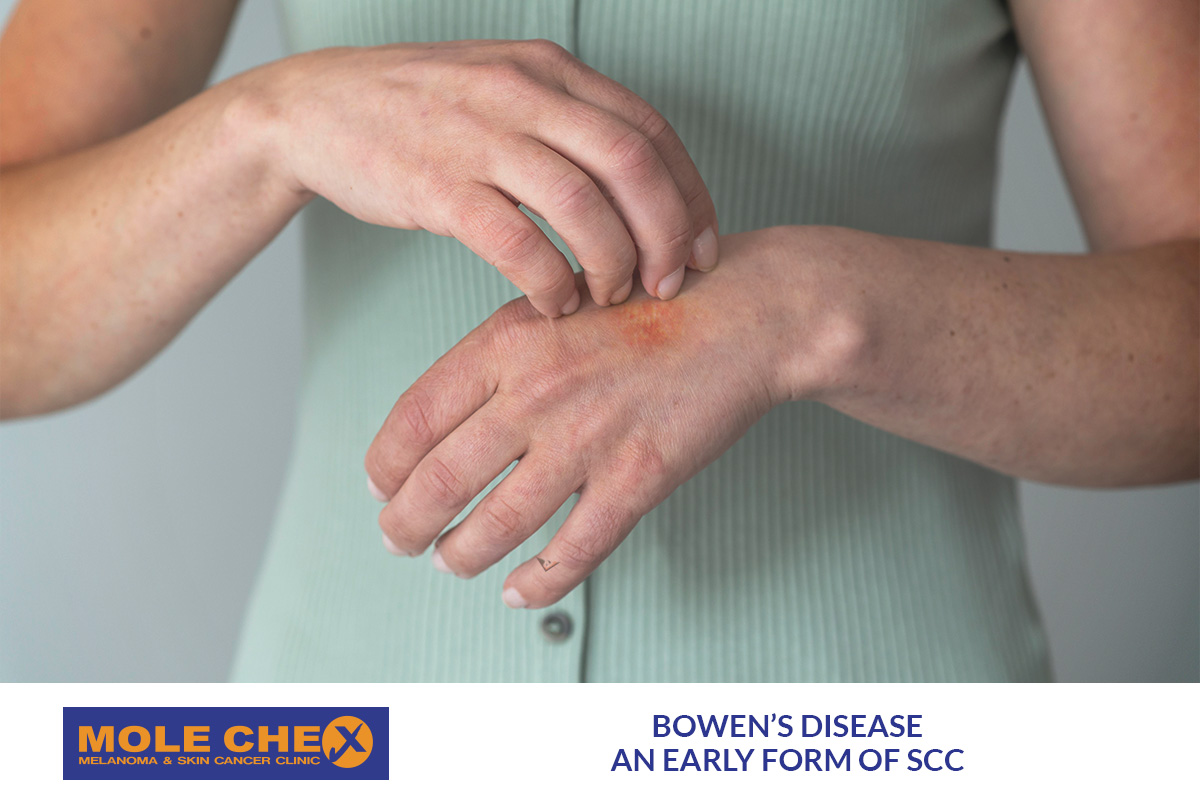
Bowen’s disease is a very early form of skin cancer. Doctors also call it squamous cell carcinoma in situ, or SCC in situ. It starts in the top layer of the skin and has not grown into deeper layers. Bowen’s disease as a very early skin cancer that often looks like a red, scaly patch.
For Brisbane residents, this matters. Queensland has the highest skin cancer rate in Australia, and Australia has the highest skin cancer rate in the world. Queensland Health links this risk strongly to ultraviolet radiation exposure. A persistent patch of rough or irritated skin should never become background noise.
What is Bowen’s disease?
Bowen’s disease is a surface-level squamous cell carcinoma. The abnormal cells sit within the epidermis, which is the outer layer of the skin. The term “in situ” means the abnormal cells have not spread beyond their original site.
That sounds reassuring, but it does not mean “ignore it”. Bowen’s disease can usually be treated successfully when found early. However, untreated Bowen’s disease can sometimes develop into invasive squamous cell carcinoma. Usually invasive SCC develops in about 5% of intraepidermal SCC lesions.
Some SCCs stay within the skin’s top layer. These may be described as SCC in situ, intra-epidermal carcinoma or Bowen’s disease. Invasive SCC behaves differently because it has moved deeper through the skin barrier.
What does Bowen’s disease look like?
Bowen’s disease can be sneaky. It may look like a slow-growing patch of skin irritation. Many people think it is dry skin, eczema, psoriasis or a fungal infection.
Common signs include:
- A red, pink, brown or orange-red scaly patch
- A rough, crusted or thickened area
- A patch that grows slowly over month
- Itching, tenderness or no symptoms at all
- A sore that crusts, bleeds or does not heal
- A patch that looks different from nearby skin
Bowen’s disease can appear on the head, neck, trunk, arms, hands and lower legs. It can also occur on lips, inside the mouth, or around genital and anal areas. It often appears on sun-exposed sites such as the ears, face, hands and lower legs.
Why Brisbane patients should pay attention
Brisbane’s outdoor lifestyle can increase cumulative UV exposure. Work, sport, gardening, school runs and weekend activities all add up. UV damage can happen even when the day does not feel hot.
Bowen’s disease often connects with long-term sun exposure. Sunlight is the cause of most cases. It also lists lowered immunity, arsenic exposure and radiation exposure as risk factors. Ultraviolet radiation can become the main cause of intraepidermal SCC.
You should take extra care if you:
- Have fair skin or burn easily
- Have worked outdoors for many years
- Have a history of skin cancer
- Have many sunspots or actinic keratoses
- Take medicines that affect immunity
- Have had organ transplant treatment
- Notice a patch that keeps returning
This does not mean every red patch is cancer. It means persistent skin changes deserve a proper skin check.
Bowen’s disease and SCC: what is the link?
Squamous cell carcinoma, or SCC, starts in squamous cells. These cells sit in the top layer of the skin. Bowen’s disease is an early stage where abnormal squamous cells remain on the surface.
If those cells grow deeper, the diagnosis may change to invasive SCC. Invasive SCC may need more urgent and involved treatment. It can also spread in some cases, especially if it grows on higher-risk sites or in people with reduced immunity.
Early detection gives patients more options. It can also reduce the chance of needing more complex treatment later.
How is Bowen’s disease diagnosed?
A skin cancer doctor may examine the area with a dermatoscope. This is a magnifying tool that helps assess skin structures. Sometimes the doctor may recommend a biopsy. A biopsy sends a small sample to a laboratory for confirmation. Biopsy can confirm the diagnosis of Bowen’s disease.
This step matters because several skin conditions can look similar. A patch may mimic eczema, psoriasis, tinea, sun damage or another type of skin cancer. Guesswork can delay care.
Molechex provides skin cancer detection, diagnosis, treatment and annual reviews in Brisbane. The clinic states that its doctors have advanced training in skin cancer, and its services include skin checks, skin cancer treatments and surgical procedures. The Molechex team page also outlines the clinic’s skin and health professionals.
Treatment options for Bowen’s disease
Treatment depends on the size, thickness, location and number of patches. Your age, health, skin type and healing ability also matter. Treatment choice depends on the lesion’s size, thickness, body site, age and general health.
Optional treatments can include any of the following techniques:
Cryotherapy
This uses liquid nitrogen to freeze abnormal cells. It may suit selected small or superficial areas.
Curettage and cautery
The doctor removes the abnormal tissue after local anaesthetic. Heat may help control bleeding and treat remaining cells. Cancer Council Australia states that curettage and electrodesiccation may treat some BCCs, small SCCs and areas of SCC in situ.
Prescription topical treatment
Some superficial skin cancers may respond to doctor-prescribed creams. These treatments need careful instructions and follow-up. Cancer Council Australia advises patients to use topical treatments only on areas their doctor has checked and directed.
Photodynamic therapy or PDT
PDT uses a light-activated treatment to target abnormal cells. Cancer Council Australia lists PDT as a treatment for sunspots, superficial BCCs and SCC in situ. Molechex also offers Photodynamic Therapy among its skin cancer and skin services.
Excision or surgical treatment
Some lesions need removal, especially when the diagnosis seems uncertain or invasive SCC may be present. Cancer Council NSW notes that surgery may be used when diagnosis is uncertain or when abnormal tissue does not respond to non-surgical treatment.
When should you book a skin check?
Book a skin check when a spot changes, grows, crusts, bleeds or looks unusual. Also book when a rash-like patch does not settle with usual care.
Do not wait for pain. Bowen’s disease often causes little discomfort. That can make it easy to overlook.
A regular skin check also helps identify other concerns. Patients with Bowen’s disease may face a higher risk of other skin cancers, including SCC, BCC and melanoma. People treated for intraepidermal SCC have increased risk of new lesions and other skin cancers.
Prevention and follow-up
For reducing future skin damage, one can use sun protection. Use SPF50+ broad-spectrum sunscreen, wear protective clothing, seek shade and avoid tanning beds. It is recommended to use sun protection, covering clothing and high-protection sunscreen for prevention.
Follow-up also matters. Bowen’s disease can return after treatment. New lesions can also appear on other sun-damaged areas. A review plan helps keep your skin monitored.
Conclusion
Molechex supports Brisbane residents with comprehensive skin checks, mole checks, skin cancer detection, Bowen’s disease assessment, treatment planning, PDT, cryotherapy, curettage and cautery, excision where clinically appropriate and annual skin reviews. If you have a persistent red, rough, crusted or changing patch, a Molechex skin consultation can help clarify the next safe step.
*Note: The information in the article is for information purposes only. This information is general in nature and does not replace professional medical advice. Please seek doctors’ appointment for actual treatment or medical condition.
Learn more by reading other articles :